

Search Icon Close Icon

Article

Responsible products: opportunities are there for companies to seize

April 3, 2025

Written by:

For most people, the link between climate change and human activity is obvious, and the negative consequences of these changes are partly attributable to their consumption. In order to reduce their environmental impact and actively participate in the fight against climate change, consumers have entered a phase of behavioral transformation that will have a direct impact on SMEs and their ability to maintain market share. If you think this will have little impact on your business, you're clearly unprepared for the wave heading your way. If your strategy is to do business as usual, you should know that the competition is preparing to put you out of business in the next few years.

Share this article

|

At a glance

ESG products are selling better, but their high price is holding them back.

Younger generations are the most inclined to pay more for responsible products.

Lack of affordable alternatives and unclear communication complicate choices.

Consumers want commitment

Even today, many Canadian companies still believe that, even if consumers say they attach great importance to the environment, corporate social responsibility (CSR) and sustainable development, their purchasing behavior remains unchanged. However, according to a survey conducted in Canada by BCG, this assumption is not entirely accurate.

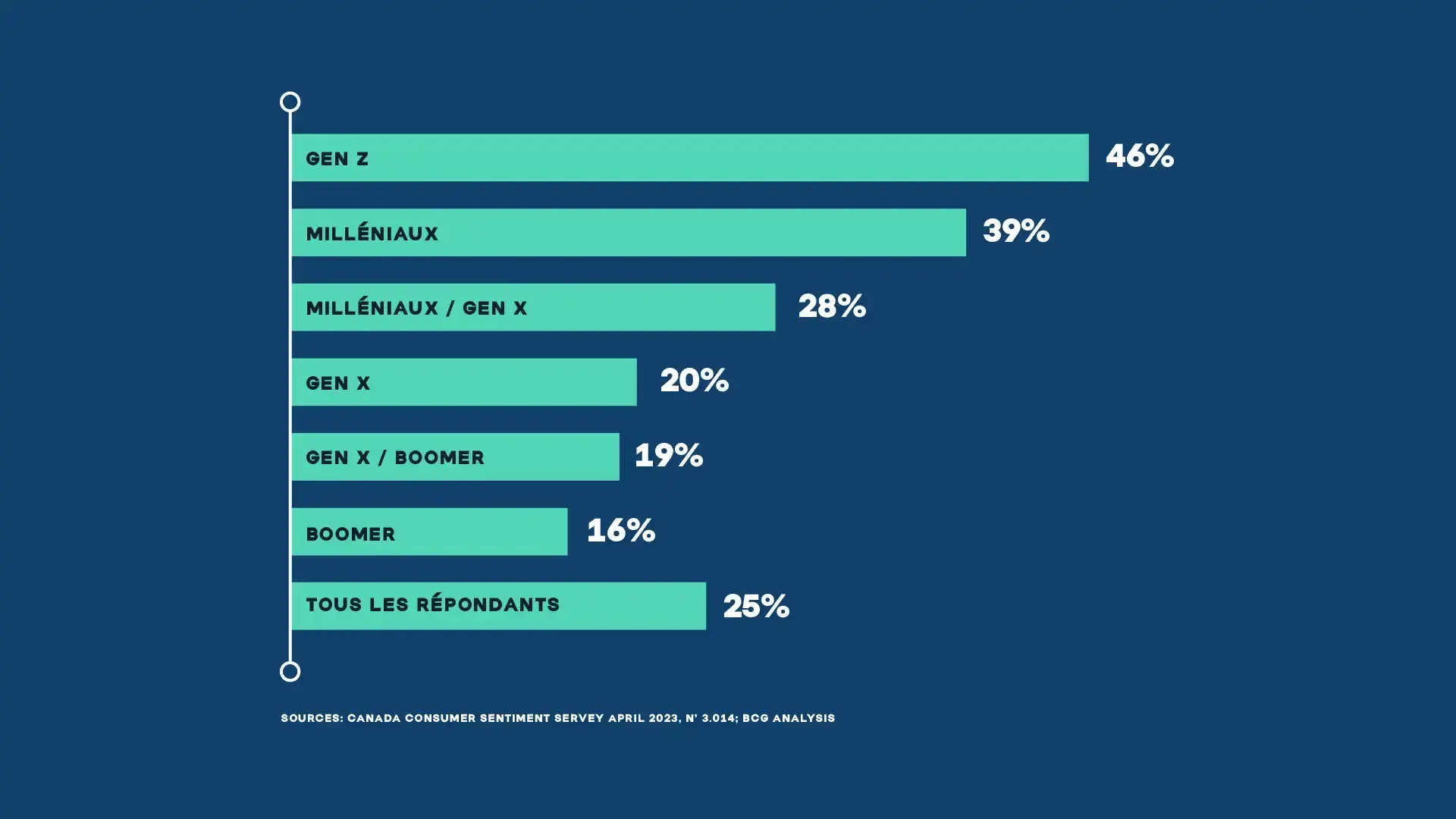
The results show that in 2023, 25% of Canadian consumers chose to pay a higher price for products with a reduced climate impact. Among Millennials, the percentage of consumers having made this choice is 39%, and among Generation Z, the percentage is 46%. In fact, the further down the age pyramid you go, the more important ESG (Environment, Social and Governance) criteria become in the purchasing decision.

Similarly, more than half the consumers surveyed (54%) by BCG said that a product’s climate impact was a “fairly important” criterion for them when making a purchasing decision, and 17% a “very important” criterion. Among Generation Z respondents with high incomes, no less than 83% mentioned a product’s climate impact as a “fairly important” criterion.

While ecology can be a positive criterion influencing the act of purchase, it can also be a discriminating criterion for certain products. In the BCG survey, 31% of consumers said they had reduced or stopped consuming certain products because of their perceived negative environmental impact. It should be noted that this is a mere perception, not a proven negative impact. So it’s no longer enough simply to market a product with certain environmental benefits; these benefits must also be strategically communicated, which is rarely the case.

Combining performance and commitment

Discover our social impact approach.

Corporate involvement translates into additional income

As consumers increasingly choose the products they buy on the basis of their environmental or societal impact, this new behavior is having a tangible effect on the revenues of the companies that meet this demand.

In 2023, a joint study by McKinsey and NielsenIQ showed that products with green or ESG claims have seen their revenues grow by 28% over the past 5 years, compared with 20% for similar products without such claims. Over these five years, “green” or ESG products have accounted for 56% of growth in over 80 product categories, and now represent almost half of total sales in these same categories.

What’s more, the study showed that, on average, products with multiple ESG factors grew faster than other products. For almost 80% of the product categories studied, the data showed a positive correlation between growth rate and the number of ESG mentions a product had. In concrete terms, products with several ESG factors grew at around twice the rate of those with just one. This suggests that consumers may be more likely to perceive that the inclusion of multiple social and environmental factors in a product correlates with genuine ESG behaviour on the part of the company, and therefore reward the company by purchasing its products.

Adoption of responsible products: supply is a problem

While studies show that the idea that consumers talk a lot, but take little concrete action, is not entirely accurate, it is not entirely unfounded. Indeed, despite consumers’ positive attitudes towards ESG factors, several studies have revealed an inconsistency between these positive attitudes and their purchasing behavior.

However, this gap between concern and action is due to the fact that consumers, including the most ecologically-minded, take into account all the attributes of a product, not just its environmental features. Although for 50% of consumers, the ecological aspect is one of the top four selection criteria, for all products, including ecological products, price is still the primary purchasing criterion, closely followed by quality and efficiency.

However, the biggest obstacles to the purchase of ecological products mentioned by consumers are that they are “too expensive”, that there are few ecological alternatives and that information is inadequate. The real problem, then, is that what’s on offer doesn’t meet consumers’ criteria, not that they don’t want more responsible products. Unfortunately, some companies confuse the rejection of overpriced, inefficient products with a lack of commitment to socially responsible products.

1. Green" products are far too expensive

Many companies still believe that the problem with consumer uptake of eco-friendly products is a lack of willingness to pay a higher price, but it’s actually the premium charged by these companies that’s the problem. According to a study by Bain & Company , the fact is that most consumers worldwide are willing to pay a premium of 12% on average for environmentally-friendly products.

Yet the average premium charged is 28%. Whatever the reasons for this overpricing, the dichotomy between supply and demand may go a long way towards explaining consumers’ supposed lack of support for eco-friendly products. Consumers want to reduce their environmental impact, but they don’t want to lose their shirt. Companies would do well to better understand their consumers and adopt carefully thought-out pricing strategies to ensure that their offerings are more in line with their expectations.

For the consumer, making a climate spending decision means navigating a confusing array of terms and labels. These include terms such as “biodegradable”, “eco-friendly”, “sustainable”, “ecological”, “natural”, “fair trade”, “organic”, “eco-designed”, “local”, “circular”, “ethical” and “zero waste”. If that wasn’t enough, let’s add labels like “Écologo”, “Energy Star”, “Énerguide”, “Fairtrade”, “Forest Steward Council”, “B-Corp”, “Marine Stewardship Council”, “Aliments Québec”, “Bio Québec” or “Projet sans OGM Vérifié”.

While for the very “green” consumer, it’s possible to assess the relevance of this information, for the traditional consumer, this information is rather confusing and doesn’t allow the relevance of the proposed option to be assessed. In fact, it only complicates the consumer’s purchasing decision and, in many cases, causes them to reject the more eco-friendly offer and turn back to the traditional products they’re familiar with. Sometimes doing too much is the same as not doing enough.

Green" marketing needs to be more strategic

Many companies experimenting with eco-friendly products start from the assumption that the environment is the consumer’s main criterion for selecting a product. Based on this mistaken assumption, they will strongly emphasize the product’s environmental impact in their marketing and communications strategy, while seriously neglecting other product attributes. It has been shown that, although ecology is now an important purchasing criterion, it is only one evaluation criterion among others. Based on this false premise, most products will never be as successful as they should be.

By focusing solely on a product’s “green” attributes, companies limit themselves to a customer segment that is highly sensitive to environmental impacts, and which unfortunately represents only a very small percentage of the population. While the vast majority of consumers show some sensitivity to environmental issues, many companies’ marketing strategies limit them to an unnecessarily small market. A deeper understanding of the consumer must guide companies in implementing a truly strategic approach to product, price and how its attributes are communicated.

1. Think "green" as a whole

Since consumers consider multiple factors in their purchasing decisions, it is necessary “to take into account all the attributes of a product and the possible interactions between them in the product development and improvement process”. In recent years, a number of companies have launched products that prioritize ecological attributes over performance.

In the majority of cases, however, when a consumer has to choose between a product’s functional attributes and its environmental credentials, he or she will prioritize the product with superior performance over the less efficient “green” product. In this context, it is only when the functional attributes are satisfied that the ecological aspect plays a positive role in the purchasing decision. When designing a “green” product, the strategy must combine concrete benefits that meet the consumer’s primary needs with benefits for the environment.

Assuming that the environment is the main criterion for product selection by the ecologically aware consumer, companies often assume that the consumer is willing to pay a significant premium for a product with a lower environmental impact. As we all know, the environmental aspect is just one of many purchasing criteria, and this alone is no guarantee that an eco-friendly product will be adopted, especially if a significant price premium is not justified by any other relevant criterion. An efficient pricing strategy must be based on the value the consumer places on the product, not on utopia. The environmental criterion may justify a slight price premium, it may positively influence the act of purchase, but it does not allow us to underestimate the consumer’s discernment.

Demanding a higher price than the average competitive price must be accompanied by a surplus value that the consumer is willing or able to conceive. On average, consumers are prepared to pay a premium of 12% for “green” products, which means that in some cases this percentage may be lower or higher than the average. When pricing a “green” product, companies tend to place too much value on the ecological aspect. To set the “right” price, it’s important to assess the market accurately and quantify the surplus value that the consumer places on the product.

Find out more about our pricing strategy

In their efforts to promote their “green” products, companies have a strong tendency to focus solely on environmental benefits. Yet studies show that the average consumer has a poor understanding of these environmental benefits and their real impact. Add to this a certain cynicism about brand messages being seen as “greenwashing”, and confusion about climate terms and labels, and messages invariably miss the mark.

In fact, the communication problem surrounding “green” products is the same as that encountered for the majority of products: communications focused on the product’s attributes and not on the value it brings to the consumer. When it comes to the environment, consumer value can be tangible, such as reducing electricity bills by using eco-responsible appliances, or intangible, such as gaining a form of moral satisfaction by doing something positive for the environment. It’s important to understand that the driving force behind a consumer’s decision is never the product itself, but its ability to satisfy a need, whether physiological or psychological.

In any case, according to Caroline Boivin and Jean-François Guertin of the Université de Sherbrooke, “Marketing communications that emphasize how a product can meet both environmental standards and personal needs will be more convincing than marketing communications that merely highlight a purely environmental benefit”.


Find out more about communication strategy

If consumers are moving towards more responsible consumption, and companies are also growing in this direction, it may be tempting for some companies to exploit the ecological and social argument in their advertising. But in this age of all-out communications, distorting reality to take advantage of a social movement entails major risks for the company involved.

Indeed, studies show that when companies fail to live up to the socially responsible initiatives they announce, they damage their customer relations and reputation, which can translate into declining sales and market share. While making a genuine commitment to the social and environmental challenges of our time is a good strategy, providing false information or knowingly exaggerating the ecological or social performance of a product or company is certainly not the idea of the century.

The opportunities are there, it's up to companies to seize them

When it comes to responsible products, the revenues of companies making the ESG shift are on the rise, in line with changes in consumer purchasing behavior. With new generations of consumers and the social and environmental upheavals we’ll be experiencing in the coming years, this trend will become a permanent feature of the factors influencing purchasing decisions. However, there is a significant gap between the glowing rhetoric of Canadian companies in terms of social and environmental performance, and the reality.

However, if this lack of realism and commitment doesn’t bode well for some companies, it leaves the way open for others to seize this opportunity and get ahead of the game in the minds of the modern consumer. It’s only a matter of time before the most agile and strategic companies seize the opportunity and take the lead. The others will be well positioned on the sidelines to watch the parade go by.

Bibliography

GOTT, James, MACKENZIE, Matt, HALLIDAY, Keith, No Longer Niche: Climate-Conscious Purchasing in Canada, Boston Consulting Group, July 2023

FREY, Sherry, BAR AM, Jordan, DOSHI, Vinit, MALIK, Anandi, NOBLE, Steve, Consumers care about sustainability-and back it up with their wallets, McKinsey & Company – NielsenIQ, February 2023


BOIVIN, Caroline, GUERTIN, Jean-François, Le marketing des produits vert : d’un marché de niche à un marché de masse, Université de Sherbrooke


The Visionary CEO’s guide to Sustainability, Bain & Company, 2023

BERLAN, Aurélien, CARBOU, Guillaume and TEULIÈRES, Laure, Greenwashing, Manuel pour dépolluer le débat public, Éditions du Seuil, March 2022

LENDREVIE, Jacques, LÉVY, Julien, Mercator, 11th ed., Dunod, Paris, 2014

IOANNOU, Iaonnis, KASSINIS, George, PAPAGIANNAKIS, Giorgos, How Greenwashing affects bottom line, Harvard Business Review, July 2022


Corporate Social Responsibility in Quebec: Perceptions, Challenges and Solutions, Institut du Québec

Jean-Éric is a business and marketing strategist renowned for his ability to transform complex challenges into strategic opportunities. With a triple expertise in business law, market analysis and marketing strategy, he supports organizations in their positioning, development and optimization of their commercial performance.

Jean-Éric Delarosbil | Business and Marketing Consultant | Squalls

See more articles