



Search Icon Close Icon

Article

Takeover and acquisition: a dangerous imbalance in business valuation

April 3, 2025

Written by:

During an acquisition, there's a lot of talk about balance sheets, margins and assets. But today's reassuring figures often mask invisible flaws, such as a brand that's running out of steam, customers that are changing or a market that's shifting. SMEs are not immune; on the contrary, they are the most exposed. If you think that good financial health is enough to guarantee a successful takeover, you may be heading straight for a dead end. And while you're relying on yesterday's indicators, others are already preparing tomorrow's growth levers.

EXPERTISE

Share this article

|

At a glance

Traditional assessments overlook key levers: marketing, branding, customer relations and team mobilization.

The success of a takeover depends on clear, shared strategic alignment right from the start.

Precise tools are available to activate these levers: diagnosis, repositioning, brand audit, optimization.

When figures mask strategic signals

An emblematic strategic error: the Snapple case

In 1994, Quaker Oats invested $1.7 billion to acquire Snapple, a fast-growing ready-to-drink beverage brand. With fast-growing annual sales, strong brand awareness and an efficient local distribution network, Snapple seemed the ideal opportunity to replicate the phenomenal success of Gatorade, Quaker Oats’ flagship brand. All the financial indicators point to inevitable success.

Yet three years later, Snapple was sold for just $300 million, a colossal loss that goes down in history as one of the most emblematic failures of corporate acquisitions. How could such a promising brand collapse so quickly? The answer lies in a fundamental strategic error: Quaker Oats neglected market dynamics and consumers’ real expectations. By disrupting the local distribution network essential to Snapple’s success, and by wrongly repositioning the brand, the company saw its loyal customer base disappear, while failing to conquer new segments.

SMEs face the same pitfalls

If even a multinational with considerable financial resources and marketing expertise can fail to understand its external environment, what can be said of small companies, buyers and acquirers? When taking over or acquiring a company, the focus is often on financial evaluation (balance sheets, assets, profitability) to the detriment of equally decisive factors such as market dynamics, marketing strategy, brand strength and customer behavior.

To avoid strategic errors and maximize the potential of an acquisition, buyers need to look beyond the obvious numbers. A broad, integrated marketing and market analysis is essential to paint a realistic picture of the company and reveal its true potential.

Company valuation: a portrait of the past, but not of potential

The blind spots of conventional approaches

Traditional business valuation is based on an accounting, financial and economic approach that focuses on the economic and sectoral context, the market and competition, financial data, customer loyalty, supplier relations, available equipment and employees. While this approach provides a solid basis for assessing past performance, it often neglects crucial aspects that determine a company’s future, including marketing, branding, consumer behavior, market dynamics and capacity to innovate. This imbalance can distort the true picture of a company and mask its potential.

1. Ignoring market dynamics: the MySpace case

Take the example of the market and the competition: a traditional analysis often focuses on current market share and direct competitors without delving into emerging trends or new consumer behaviors. Yet it is these changing dynamics that determine whether a company will be able to maintain its position or grow. A company may dominate its market today, yet be ill-equipped to respond to technological evolutions or the expectations of a new generation of consumers.

The resounding failure of News Corporation’s acquisition of MySpace in 2005 illustrates this pitfall. By focusing solely on MySpace’s market share at the time of the transaction, without taking into account the rise of Facebook, changing user behaviors and technological advances, News Corporation underestimated the challenges of a rapidly evolving social networking market and suffered colossal losses.

Marketing and branding, on the other hand, play a decisive role in a company’s longevity, but are often underestimated in a conventional valuation. A strong brand is an intangible asset that directly influences customer loyalty and perception, and the ability to conquer new customer segments or markets. A well thought-out marketing strategy not only boosts brand awareness and commitment, but also enables the company to adapt to customer needs in a constantly changing environment. However, these elements are not always reflected in financial reports or traditional accounting approaches.

Consumer behavior is another factor that is often overlooked or misunderstood. Buying habits evolve rapidly, influenced by social, technological or cultural trends. A company can appear to be thriving while losing relevance if it fails to respond to these changing expectations. For example, a brand that neglects the transition to digital channels or fails to adapt to consumers’ environmental concerns may find itself out of date, even if its current financial performance appears solid.

Finally, a company’s capacity for innovation is a key indicator of its potential. In a world where markets are constantly being redefined by new entrants and disruptive technologies, a company that doesn’t invest in innovation risks stagnating. Yet this capacity to innovate, whether in terms of products, services or business models, is not always measurable through conventional financial evaluation. Ignoring this aspect can lead to acquisitions of companies that are not prepared for the future.

Buying a company: thinking beyond financial statements

So, while financial valuation remains indispensable, it cannot be the sole compass for an acquisition. Acquirers must broaden their analysis to include strategic dimensions such as marketing, brand positioning, consumer behavior and capacity to innovate. It is by combining these elements with financial data that a complete picture of the company can be obtained, not only of what it has achieved, but also of what it can become.

Due diligence: a strategic analysis to reveal the real stakes

The blind spots of conventional checks

In an acquisition process, due diligence helps validate the information provided by the seller and identify certain risks. Unlike financial appraisal, which focuses primarily on past performance, due diligence takes a more global approach, examining the company’s financial, legal, operational and strategic aspects.

1. The hidden face of intangible assets

Although these aspects are indispensable, they are not sufficient to reveal all the strategic stakes. For example, intangible assets such as brand reputation, customer loyalty or marketing capabilities are rarely taken into account in a traditional analysis, even though they play a central role in value creation. A company that looks solid on paper may hide significant strategic vulnerabilities, such as inadequate marketing positioning or products that are not adapted to new consumer buying behaviors.

For example, a company with a strong but poorly exploited brand may offer significant growth potential, provided the acquirer knows how to capitalize on this asset. Ignoring the marketing strategy during due diligence can thus lead to an underestimation of the efforts required to maintain or develop the post-acquisition customer base.

Traditional analysis, which often focuses on current market share and direct competitors without exploring emerging dynamics and consumer behavior in depth, fails to determine whether a company can maintain its position or grow in the future. Microsoft’s failed acquisition of Nokia in 2014 is a perfect example. By failing to take into account the behaviors of consumers already loyal to Android and iOS, and by underestimating the growing dominance of these ecosystems, Microsoft missed its bet and suffered massive losses.

Finally, in an environment where markets are changing rapidly as a result of technological disruptions, a company’s ability to innovate or adapt is essential to ensure its long-term survival. The example of Kodak, which failed to anticipate the transition to digital photography despite its expertise in silver halide, illustrates the extent to which a lack of strategic vision can doom a once prosperous company.

Adopting a broader approach to due diligence

To optimize due diligence, buyers need to integrate strategic and forward-looking dimensions. Analyzing the brand’s marketing strategy and capabilities, its consumers and its positioning, helps to better understand its differentiation from competitors, and to identify untapped opportunities such as underserved segments or under-exploited digital channels.

Marketing audit as a negotiation tool

Identifying hidden overvaluations

A well-conducted marketing audit can reveal decisive elements that call into question a company’s initial valuation. In some cases, it highlights an overestimation of the company’s value. For example, a brand perceived as strong may in fact suffer from a weakened reputation, or a loyal customer base may prove unstable, dependent on passing trends or aggressive promotions. These discoveries enable buyers to adjust their offer downwards and avoid paying an excessive price.

Revealing untapped potential

Conversely, a marketing audit can also reveal untapped opportunities, such as an insufficient digital presence, ignored market segments or poorly optimized positioning, which temporarily limit a company’s performance, but offer significant growth potential.

This information, which is often missing from traditional financial valuations, can be used to spot a good deal, where the buyer, by investing in the right marketing levers, can rapidly create value and turn an underestimated business into a real success.

Company takeover

Diagnosis, strategy and customized support.

Marketing evaluation as the basis for a post-acquisition growth strategy

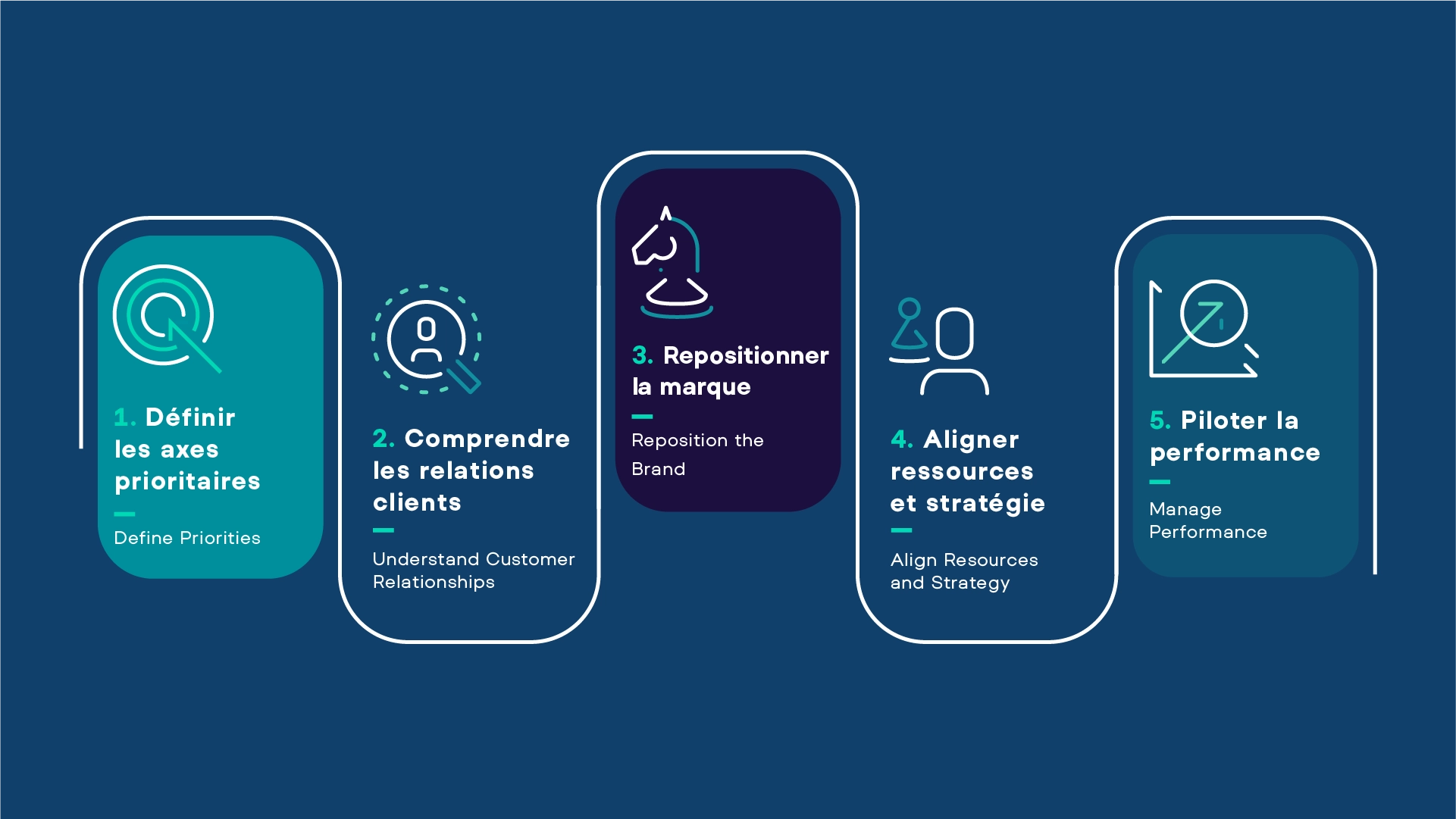
1. Define priorities

Valuation andmarketing audits are not limited to estimating a company’s value before acquisition, but also form an essential basis for building a solid and effective post-acquisition growth strategy.

A marketing assessment can first be used to identify priority areas for development. For example, if the analysis shows that the company is targeting saturated market segments, it may be possible to identify under-exploited niches or as yet untapped geographical territories. Similarly, an audit may reveal a limited digital presence, representing an immediate opportunity to extend the company’s reach via online channels or social network advertising campaigns.

Similarly, an in-depth analysis of customer relationships helps to understand their expectations and degree of loyalty. For example, an audit may reveal that a large proportion of revenues are based on recurring but aging customers, requiring efforts to attract a new generation of consumers. It is also possible to identify opportunities to reactivate former customers through targeted offers or direct marketing initiatives.

A strong brand, when well exploited, can become a post-acquisition growth gas pedal. However, marketing evaluation can sometimes reveal a mismatch between brand perception and market expectations. A brand with an aging or misaligned identity needs to be repositioned to regain relevance. A thoughtful growth strategy might also include geographic expansion or entry into adjacent markets, building on existing brand awareness and reputation.

Find out more about strategic repositioning

Marketing assessment also helps to align internal resources with strategic objectives. Once opportunities have been identified, it’s crucial to ensure that the teams in place have the skills and tools needed to exploit them. For example, a company that lacks digital expertise may need to invest in training or hiring new talent. Moreover, harmoniously integrating the acquired corporate culture with the new objectives can be decisive in maximizing the coherence and effectiveness of post-acquisition actions.

Find out more about our support services

Finally, marketing evaluation provides the basis for measuring and adjusting long-term performance. By defining key performance indicators (KPIs), buyers can track the effectiveness of marketing initiatives, the profitability of advertising campaigns or the evolution of customer loyalty. For example, a company repositioning its brand can monitor indicators such as increased awareness, market share or sales trends to adjust its strategy in real time.

Five phases of support

An enlightened acquisition for lasting success

Taking over or acquiring a company is a unique opportunity to create value, but it requires a rigorous, multi-dimensional approach. While financial valuation remains an essential pillar, it must not overshadow essential strategic factors such as marketing, branding, innovation and consumer dynamics. These elements, often neglected in traditional approaches, play a decisive role in post-acquisition sustainability and growth.

Historical examples, such as Snapple, MySpace or Nokia, illustrate the risks associated with poor analysis. Increased diligence and a thorough understanding of market trends, customer expectations and internal capabilities can reveal a company’s true potential. By integrating these dimensions from the earliest stages, acquirers and buyers can not only avoid costly pitfalls, but also lay the foundations for a sustainable growth strategy.

In short, the successful acquisition of a company is not based on a simple addition of figures, but on a strategic vision capable of uniting past performance and future opportunities. It is this combination of analytical rigor and strategic creativity that transforms a transaction into a true entrepreneurial success.

Jean-Éric is a business and marketing strategist renowned for his ability to transform complex challenges into strategic opportunities. With a triple expertise in business law, market analysis and marketing strategy, he supports organizations in their positioning, development and optimization of their commercial performance.

Jean-Éric Delarosbil | Business and Marketing Consultant | Squalls

Related articles